What If Mountains Could Talk? Milford Sound’s Hidden Architectural Secrets
Imagine standing where rock meets sky, and human design quietly blends with nature’s grandeur. Milford Sound isn’t just about waterfalls and fiords—it’s where remote lodges, walkways, and shelters are built to vanish into the wilderness. I wandered through this UNESCO site, stunned by how architecture here doesn’t dominate but listens. Every structure feels like a whisper, not a shout. This is design shaped by weather, terrain, and reverence for place—a lesson in harmony few places teach so powerfully.
The Landscape That Shapes Design
Milford Sound, nestled in the southwest of New Zealand’s South Island, is one of the planet’s most dramatic natural environments. Towering granite cliffs rise over a mile above deep, still waters, while rainfall averages more than 6,000 millimeters annually—among the highest in the world. This extreme climate and rugged topography are not just scenic features; they are the fundamental forces shaping every architectural decision in the region. Engineers and designers must begin not with aesthetics or convenience, but with survival: survival of the structures themselves, and of the people who use them. The landscape does not tolerate arrogance. Any building must respect the land’s rhythm, its slopes, its storms, and its silence.
Materials are chosen for resilience above all. Weather-resistant native timber like rimu and kauri is often used, treated to withstand constant moisture without warping or rotting. Steel frames are galvanized to resist corrosion, and roofing materials are selected for their ability to shed water efficiently under relentless downpours. Many structures are elevated on stilts or concrete piers to prevent water damage during flash floods and to minimize soil disturbance. This elevation also allows for natural drainage and reduces the risk of landslides affecting foundations. Earthquake-resistant design is another non-negotiable. Positioned near the tectonically active Alpine Fault, buildings are engineered with flexible joints, reinforced walls, and deep anchoring systems to absorb seismic shocks without collapsing.
Because of the steep terrain, access routes must be carefully planned. Roads and trails follow natural contours rather than cutting across them, reducing erosion and preserving vegetation. Bridges are built with lightweight composite materials that distribute weight evenly and require less excavation. Helipads are often the only viable option for delivering heavy machinery or large components, and even then, flights are scheduled around unpredictable weather windows. Every design choice—from the angle of a roof to the placement of a single support beam—is dictated by the land itself. In Milford Sound, architecture is not imposed; it is invited.
Human Presence, Minimal Footprint
In a place of such overwhelming natural beauty, the guiding principle for human structures is clear: do not compete. The visitor centers, viewing platforms, and basic accommodations scattered throughout the area are not designed to be destinations in themselves, but rather quiet facilitators of experience. Their role is to enable connection—not to draw attention. This philosophy is rooted in the Māori concept of kaitiakitanga, or guardianship of the land, which emphasizes responsibility, respect, and sustainability. Every built form here reflects that ethos, prioritizing function, longevity, and environmental sensitivity over spectacle.
Walkways are constructed from durable, low-impact materials such as recycled composite decking, which resists wear from thousands of boots while avoiding the need for frequent replacement. Viewing platforms are positioned to frame specific vistas—Mitre Peak reflected in the still water, or cascading waterfalls after heavy rain—without obstructing sightlines or requiring extensive clearing. Seating is simple and strategically placed, often made from locally sourced timber with minimal treatment to allow natural weathering. Even trash and recycling stations are discreetly integrated into the landscape, hidden behind vegetation or built into rock formations.
Sustainable practices extend beyond materials. Solar panels are used to supplement power needs, especially in remote huts where grid connection is impossible. Rainwater harvesting systems collect and filter water for non-potable uses, reducing strain on natural sources. Waste management follows strict protocols—organic waste is composted where possible, and all non-biodegradable materials are transported out by boat or helicopter. The goal is not just to leave no trace, but to ensure that the presence of people enhances understanding rather than degrades the environment. These structures serve as subtle teachers, showing visitors how to move through nature with care.
The Art of Disappearing: Blending with Nature
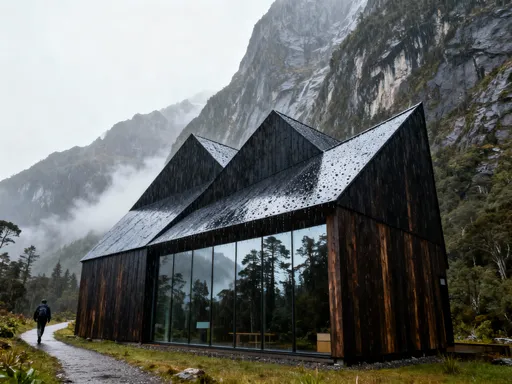
One of the most remarkable aspects of architecture in Milford Sound is its ability to vanish. At first glance, many structures seem absent, hidden among trees or tucked into rock faces. This is no accident. Architects employ a range of techniques to ensure that buildings merge with their surroundings rather than disrupt them. Roofs are often pitched at angles that mirror the surrounding mountain slopes, creating a visual continuity that tricks the eye. Exterior cladding is stained in deep charcoal or forest green, allowing wood to fade into shadow and blend with moss-covered rocks. Glass walls are strategically placed to reflect the canopy, making the building appear transparent from certain angles.
Sightlines are meticulously calculated. From key vantage points—such as the ferry terminal or popular photo spots—structures are positioned just below the horizon line or shielded by natural berms and plantings. This ensures that when visitors look out across the fiord, their view remains uninterrupted by human-made forms. Even chimneys and vents are minimized or disguised as rock outcroppings. The result is a built environment that feels organic, as though it grew from the land rather than was placed upon it.
This design approach is not merely aesthetic; it is psychological. By minimizing visual intrusion, architects help preserve the sense of awe that draws people to Milford Sound in the first place. When a building does not demand attention, the landscape can speak for itself. The sound of rain on leaves, the distant crash of a waterfall, the slow drift of mist across the water—these become the dominant sensations. Architecture, in this context, is not about expression, but about restraint. It is a silent partner in the experience, ensuring comfort and safety without ever stealing the spotlight.
Engineering in Isolation: Building Where Few Can
Constructing anything in Milford Sound is an act of patience, precision, and perseverance. The nearest major town, Te Anau, is over 120 kilometers away by winding mountain roads. There are no local suppliers, no hardware stores, and no quick fixes. Every nail, beam, and bolt must be transported in advance, often months before construction begins. This logistical challenge demands meticulous planning and a deep understanding of seasonal patterns. Work is typically scheduled during the drier summer months, when helicopter flights are more reliable and ground crews can access remote sites without sinking into mud.
Barges are used to transport larger materials along the fiord, docking at temporary wharves that are dismantled after use to avoid permanent alteration of the shoreline. Helicopters lift prefabricated modules—entire room sections, bathrooms, kitchens—directly into place, minimizing on-site construction time and environmental impact. These modules are built off-site in controlled environments, ensuring quality and reducing waste. Once assembled, they are sealed against moisture and insulated for extreme conditions. Temporary access trails are created using permeable geotextile fabric and gravel, which prevent erosion and can be removed or revegetated after use.
Labor crews face unique challenges. Weather delays are common, and safety is paramount in an environment where storms can roll in without warning. Workers must be trained not only in construction techniques but in wilderness survival, first aid, and environmental protection. Communication is limited, and medical evacuation can take hours. Despite these hardships, there is a deep sense of pride among those who build here. They understand they are not just constructing buildings—they are crafting gateways to one of Earth’s last truly wild places. Their work is temporary in human terms, but designed to last generations without harming the land.
A Sheltered Journey: The Role of Trailside Structures
For hikers exploring the trails near Milford Sound—such as the famous Kepler Track or the lesser-known Clinton Valley route—small shelters play a vital role in safety and comfort. These structures are not luxurious; they are simple, functional, and deeply thoughtful. Typically no larger than a garden shed, they offer protection from rain, wind, and cold, with enough space for a few people to rest, eat, or wait out a storm. Their design is a masterclass in practical minimalism. Roofs are steeply pitched to prevent water buildup, with wide overhangs to keep rain from entering. Walls are partially open or louvered to allow ventilation while blocking wind, preventing condensation and maintaining air quality.
Seating is built into the walls at ergonomic angles, often with backrests shaped to support tired hikers. Flooring is made of durable, slip-resistant material, sometimes raised slightly to avoid pooling water. Information boards inside provide trail maps, weather updates, and safety tips, printed on weatherproof materials. Some shelters include small fireplaces for emergency warmth, though these are rarely used due to fire risk and environmental regulations. Instead, radiant heat panels powered by solar energy are increasingly common.
These shelters are spaced at regular intervals, usually a day’s hike apart, allowing for safe multi-day treks. Their placement considers not only distance but also natural landmarks—near streams for water access, or on high ground for better visibility. Signage is subtle, using carved wood or stone markers that blend with the environment. In every detail, these structures reflect a deep understanding of human need in a demanding landscape. They do not seek to impress, but to serve. And in doing so, they become essential companions on the journey through the wilderness.
Visitor Centers as Gateways, Not Attractions
The visitor centers in Te Anau and Milford Sound serve a crucial educational and orienting function. They are the first point of contact for most travelers, offering maps, weather forecasts, guided tour bookings, and insights into the region’s geology, ecology, and cultural history. But unlike many tourist hubs, these centers are not designed to dazzle. Their architecture is intentionally understated, acting as a transitional space between the modern world and the wild. The goal is not to excite, but to prepare—mentally, emotionally, and practically—for what lies ahead.
Both centers use local stone and timber in their construction, with sloped roofs that echo the surrounding peaks. Large windows face the water or mountains, framing views like living paintings. Natural light floods the interiors, reducing energy use and creating a calm, welcoming atmosphere. Exhibits are interactive but low-tech, emphasizing storytelling over spectacle. One display might explain how glaciers carved the fiords over millions of years; another might highlight the native birds returning thanks to conservation efforts. There are no flashing screens or loud sounds—just quiet spaces for reflection.
The layout encourages slow movement. Visitors enter through a narrow passage that opens into a wider hall, mimicking the experience of emerging from a forest into a clearing. Restrooms, cafes, and gift shops are tucked to the sides, avoiding dominance over the central space. Even the café menu reflects local values, featuring sustainably sourced ingredients and minimal packaging. These centers do not try to be the highlight of the trip. Instead, they honor the journey by helping people understand what they are about to witness. They are thresholds, not destinations—a quiet reminder that nature is the true star.
Design Lessons Beyond the Fiord
Milford Sound offers more than breathtaking scenery; it offers a masterclass in architectural humility. In an age of soaring skyscrapers and bold, attention-grabbing designs, this remote corner of New Zealand reminds us that the most powerful structures are often the quietest. The principles seen here—respect for terrain, use of sustainable materials, minimal visual impact, and thoughtful integration with nature—have global relevance. Urban planners, resort developers, and architects worldwide can learn from this model of restraint and responsibility.
Imagine cities where buildings respond to local climate rather than fighting it—green roofs in rainy regions, shaded courtyards in hot climates, windbreaks in exposed areas. Picture eco-resorts that don’t dominate beaches but nestle into dunes, using natural ventilation and solar power to reduce dependence on grids. Consider public parks where restrooms and shelters are designed to disappear, preserving the sense of escape and tranquility. These are not fantasies; they are extensions of what already works in places like Milford Sound.
Moreover, this approach fosters a deeper relationship between people and place. When architecture listens instead of shouts, it invites mindfulness. It teaches visitors to slow down, to observe, to appreciate. It transforms tourism from consumption into connection. And in doing so, it helps protect the very landscapes it celebrates. As climate change and overdevelopment threaten natural spaces around the world, the lessons of Milford Sound become more urgent. Design does not have to conquer to be meaningful. Sometimes, the greatest strength is knowing when to be still, when to blend, when to let the mountains speak—and simply build a shelter that lets us hear them.